


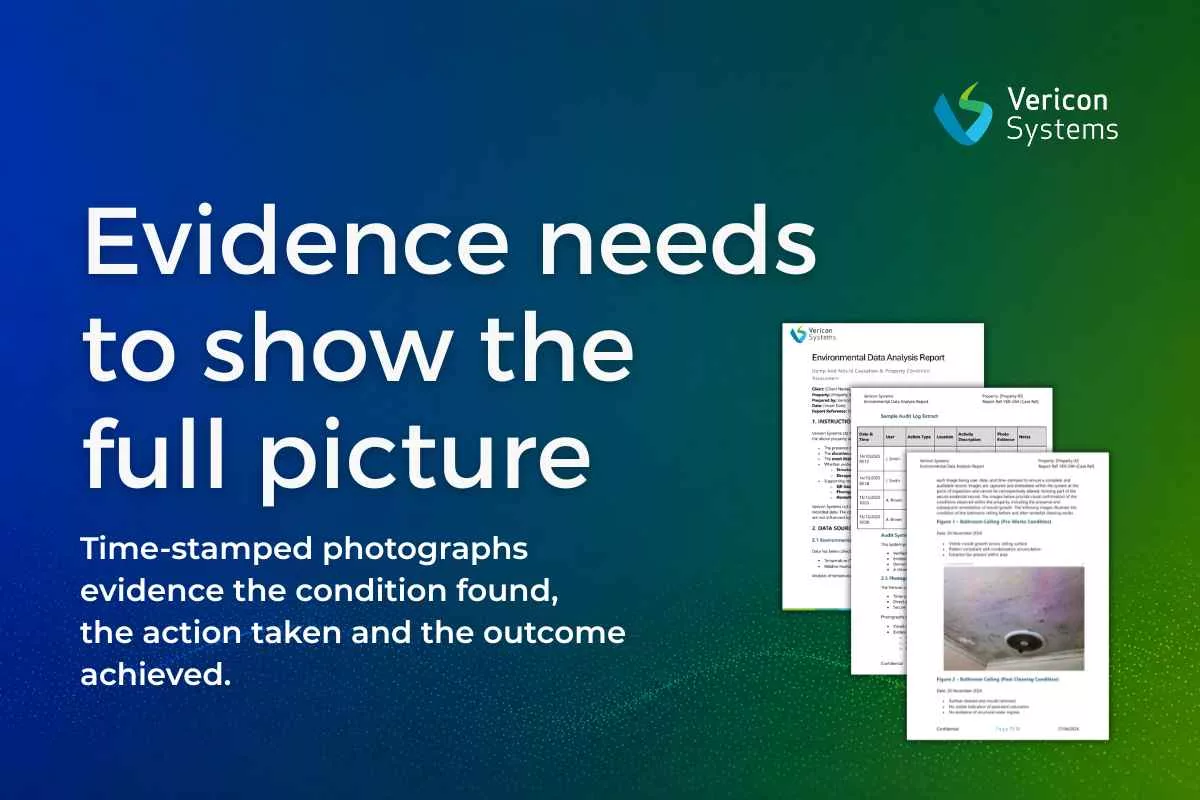
A damp and mould inspection can be an important part of a landlord’s response. But it is still only one moment in time. A surveyor may attend,...
Why Damp and Mould Evidence Breaks Down After the Inspection
read more...
They need to evidence what was known, when it was known, what was communicated, what action was taken and whether the outcome improved.
That is a major operational shift.
Across damp and mould, Awaab's Law, retrofit, emergency lighting, water hygiene, heating and resident communication, the sector is moving from activity-based management to evidence-led assurance.
The issue is not always that landlords are failing to act.
In many cases, the issue is that the evidence behind that action is fragmented, difficult to access or reconstructed after the event.
That creates a growing evidence gap.
And that evidence gap costs time, money and risk.
The evidence gap is the space between what a landlord has done and what the landlord can clearly prove.
It appears when information is spread across disconnected systems, manual processes, contractor notes, resident communications, inspection reports, spreadsheets and one-off site visits.
For example, a damp and mould case may involve:
If those pieces of evidence sit in different places, the response becomes harder to manage and harder to prove.
That matters because housing teams are no longer judged only on whether work was completed.
They are increasingly judged on whether the full response was visible, timely, resident-aware and evidenced.
Social landlords are being asked to manage more risk, prove more action and improve more outcomes — while working with fragmented systems and limited live visibility inside homes.
Evidence gaps do not only create compliance risk.
They create operational waste.
When evidence is incomplete or disconnected, teams spend more time chasing information, repeating inspections, checking contractor updates, responding to complaints and rebuilding timelines.
That can affect multiple teams at once:
Repairs teams may dispatch engineers without enough context — with no-fault-found call-outs commonly costing between £150 and £300 each, avoidable visits add up quickly.
Damp and mould teams may rely on snapshot inspections rather than live environmental evidence.
Compliance teams may need to manually compile audit records.
Sustainability teams may struggle to prove what changed after retrofit works.
Resident engagement teams may find it difficult to evidence communication attempts.
This is where the cost builds — not always as a single visible budget line, but through repeated work, avoidable visits, duplicated admin, weak triage and time spent proving what should already be clear.
The commercial question is not just: What does the technology cost?
The stronger question is: What is the current evidence gap already costing the organisation?
Damp and mould is one of the clearest examples of the evidence gap.
A landlord may know there is a problem. A sensor may show that a risk exists. A resident may have reported an issue. A contractor may have attended.
But the evidence challenge is wider. Teams need to understand the conditions behind the risk:
Detection is useful, but detection alone is not diagnosis.
Vericon supports damp and mould teams by connecting environmental monitoring, heating insight, resident communication and reporting into a clearer evidence-led workflow.
Through MouldSense, Surveyor Cube, MultiDOT, HomeHub and Connect / Portal, landlords can build a more complete view of damp and mould risk, action and outcome evidence.
For landlords preparing for Awaab's Law, the issue is not only how quickly a response can be made — it is whether the landlord can evidence the full response from first signal to final outcome.
Awaab's Law has increased the focus on damp and mould response times, but the operational impact goes beyond timescales.
Landlords need to show that they had a clear process, used the right information, communicated appropriately and acted on the risk.
That requires an evidence chain — one where landlords may need to demonstrate when a risk was identified, how it was investigated, what was communicated, what action followed and whether conditions improved.
That evidence chain becomes weaker when information is spread across different teams and systems. A stronger approach connects the relevant evidence earlier:
That is the shift from reactive case management to Prevention + Proof.
Retrofit is another area where the evidence gap can create commercial and operational pressure.
An installation record tells a landlord what was fitted. It does not always show what changed.
For retrofit and low-carbon heating programmes, landlords need to understand whether homes are warmer, healthier, more comfortable and performing as intended. That requires both baseline and post-works evidence.
Without baseline data, it becomes harder to prove the impact of the intervention. Without post-works monitoring, it becomes harder to understand whether the investment is delivering the intended outcome.
Vericon supports retrofit evidence by connecting heating performance, room-level temperature and humidity, energy use and resident engagement — giving asset, sustainability and investment teams a stronger evidence base for programme decisions, resident support and future planning.
Compliance activity can also create evidence gaps. Emergency lighting testing is a good example.
Manual testing can involve scheduled visits, contractor attendance, manual records, follow-up actions and audit preparation. The task itself matters — but the evidence behind the task matters too.
Vericon's EmeRed supports a more evidence-led approach by automating emergency lighting testing, recording pass/fail results and supporting exception-based maintenance.
Test automatically. Maintain by exception. Evidence every result.
This does not remove the need for professional oversight. It helps reduce routine manual burden and gives compliance teams clearer evidence of what has happened across the estate.
Water hygiene and Legionella risk management can also be heavily dependent on manual processes — particularly in void properties, under-used outlets and restricted-access areas.
Traditional workflows may rely on scheduled flushing, site attendance, temperature checks and manual logbooks. Those processes may remain necessary, but they can be difficult to evidence consistently at scale.
Vericon's LegionellaGuard is designed to help dutyholders manage water hygiene evidence more effectively. It monitors hot and cold outlet performance, identifies stagnation and temperature risk, supports controlled flushing where compatible taps are installed and creates audit-ready records — while making clear that it supports dutyholders and does not replace competent-person responsibility.
The commercial value is not based on claiming that all visits disappear. It is based on helping landlords move from manual records alone towards connected compliance evidence and exception-based workflows.
The evidence gap affects different teams in different ways.
For damp and mould leads, it creates pressure around investigation, prioritisation and outcome evidence. For compliance teams, audit trails and defensible records. For repairs and maintenance teams, triage, repeat visits and no-fault-found outcomes. For sustainability teams, proving retrofit performance. For finance teams, value for money and avoidable cost. For senior leaders, portfolio-level assurance.
Disconnected evidence makes it harder to act early, harder to act efficiently and harder to prove what happened.
Connected intelligence helps close that gap.
Many landlords already have systems for repairs, compliance, asset management and resident contact. The issue is that those systems often record activity in isolation. Assurance requires connection.
Vericon connects live data from homes, assets, residents and compliance workflows into one intelligence and evidence layer — supporting earlier risk identification, better-informed action and clearer outcome evidence.
For social landlords under pressure, this does not need to start as a full transformation project. It can start with one urgent evidence gap.
The strongest starting point is the problem already costing time, money or risk. From there, the right question is:
Where would connected evidence make the biggest difference in the next 90 days?
Vericon helps social landlords move from fragmented evidence to connected intelligence.
Across damp and mould, Awaab's Law, retrofit, emergency lighting, Legionella risk management, heating and resident communication, Vericon supports teams with earlier visibility, clearer workflows and stronger evidence.
The aim is not to add another disconnected dashboard. The aim is to connect the evidence landlords already need to manage risk, reduce operational pressure and improve resident outcomes.
If your team is currently reviewing damp and mould evidence, retrofit performance, emergency lighting testing or Legionella compliance, Vericon can help you assess where fragmented evidence is creating pressure.
Vericon Systems — Where Connected Data Becomes Intelligence.
If your team is currently reviewing damp and mould evidence, retrofit performance, emergency lighting testing or Legionella compliance, Vericon can help you assess where fragmented evidence is creating pressure.
Vericon Systems — Where Connected Data Becomes Intelligence.
A damp and mould inspection is only one moment in time. Learn how environmental data, photographs, audit records and resident communication can form a clearer case record.
Wave 3 delivery has shifted the goalposts. Sustainability teams are now expected to deliver verified decarbonisation, EPC C uplift, fuel poverty impact, and improved indoor environmental quality — while staying inside strict spend profiles and operating under increased scrutiny from the Regulator of Social Housing and the Housing Ombudsman.
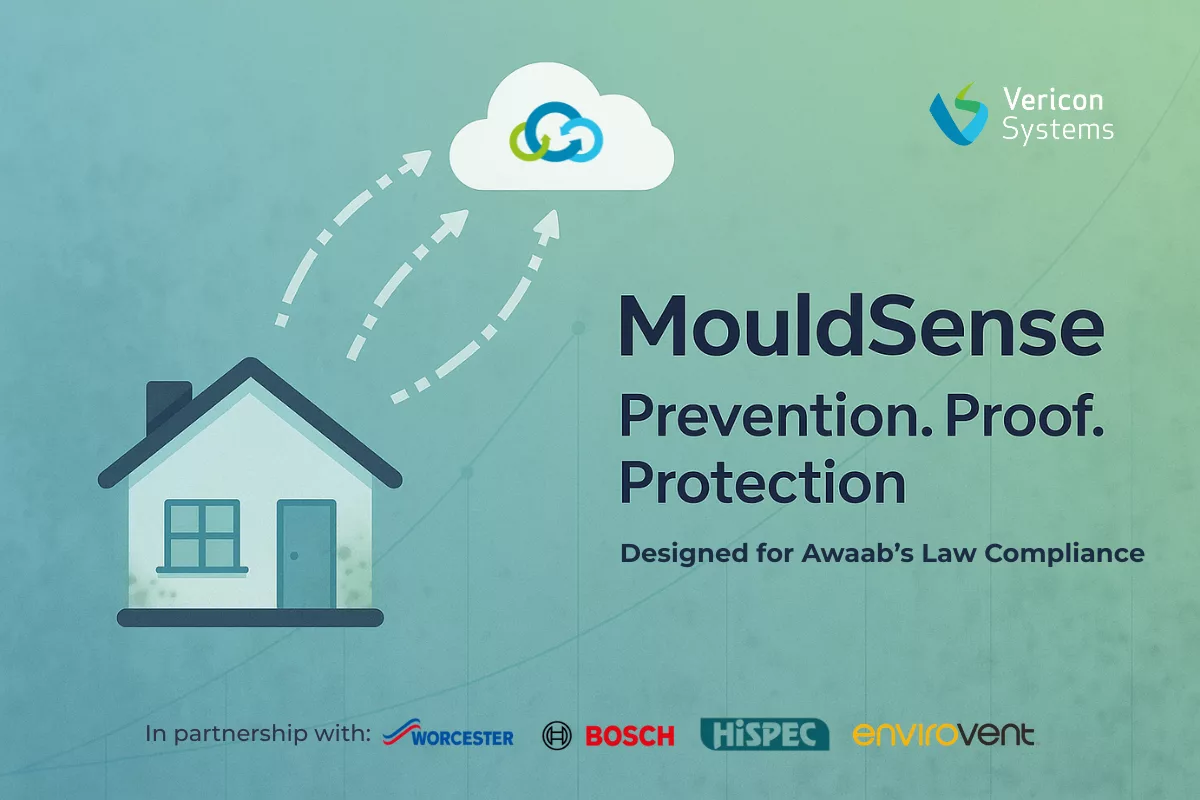
MouldSense brings prevention and proof together in one connected workflow. Monitor temperature and humidity, guide investigations, validate works and report with confidence—without juggling spreadsheets and site notes. See risk sooner, act faster and evidence improvement across your stock.