



Social landlords are under pressure to do more than respond. They need to evidence what was known, when it was known, what was communicated, what...
The Evidence Gap Costing Social Landlords Time, Money and Risk
read more...
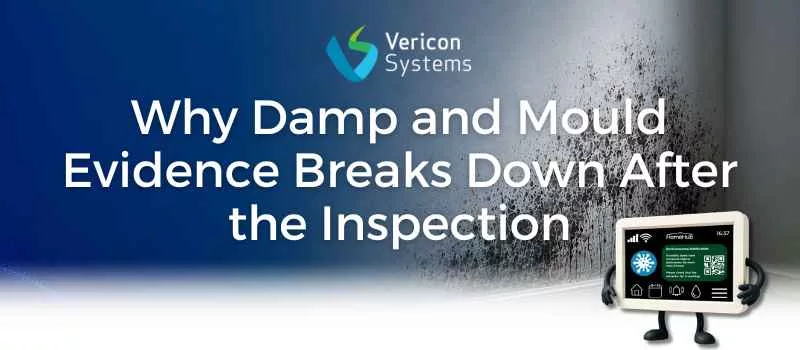
But it is still only one moment in time.
A surveyor may attend, record findings, take photographs, test ventilation and recommend work. That activity matters. However, when a case is reviewed later, a single survey report or folder of photographs may not explain what happened before the visit, what action followed or whether conditions improved.
This is where damp and mould evidence often breaks down.
Environmental data may sit in one system. Inspection notes may sit in a repairs platform. Photographs may be stored in contractor folders. Resident communication may be held in emails, letters or CRM records.
The result is often a collection of disconnected documents rather than a clear property narrative.
For social landlords managing damp and mould risk, complaints and case escalation, the challenge is not simply proving that an inspection took place. It is being able to show the full response.
A site visit can confirm what was observed on that day.
It can identify visible mould, assess ventilation, record property condition and trigger further investigation or repair work. However, it does not always explain whether the issue was isolated, recurring or linked to sustained environmental conditions.
That wider context matters.
Temperature and humidity trends can help teams understand whether moisture levels remained elevated over time, whether humidity reduced after moisture events and whether lower temperatures or poor ventilation may be contributing to risk.
This is why damp and mould management needs more than a snapshot inspection.
It needs a record that connects:
An isolated humidity reading does not explain a damp and mould case.
Short-term humidity increases can be expected after bathing, showering or cooking. The more relevant issue is whether elevated humidity is sustained, whether it clears at an expected rate and whether it is linked to low temperatures, ventilation performance or wider property conditions.
A stronger evidence process helps teams move beyond raw readings.
It allows them to understand the likely significance of environmental patterns, prioritise the right action and build a clearer picture of the property over time.
The Environmental Data Analysis Report uses temperature and humidity trends, ventilation response and sustained risk conditions to support a structured assessment of the case. It is designed to help distinguish between isolated events and longer-term patterns that may require intervention.
Photographic evidence is often treated as a supporting document.
It should be part of the case record.
A time-stamped photograph can show the condition found during an inspection. It can record the presence or absence of mould, ventilation status, property condition, remedial works and the condition after action has been taken.
This is particularly valuable when photographs are linked directly to site activity and environmental evidence.
For example, before-and-after photographs can help show:
The Environmental Data Analysis Report includes photographic evidence as part of a wider evidential record, rather than as a separate collection of images. Its sample report shows how pre- and post-works photographs can sit alongside audit activity, environmental trends and findings.
A landlord response is not complete simply because a repair has been raised.
Residents may need guidance around heating, ventilation, moisture management, access, inspections, appointments and next steps. That communication should be clear, timely and connected to the wider case record.
HomeHub provides a direct in-property communication route, helping social landlords issue relevant messages and guidance into the home. Messages, alerts and engagement can form part of the wider property record rather than sitting separately from monitoring and inspection evidence.
This is not about assigning blame.
It is about giving residents clear information and support while helping housing teams demonstrate what was communicated, when it was issued and what action followed.
The strongest damp and mould case records do not rely on one source of evidence.
They bring together the full picture:
This makes it easier for teams to understand what happened at the property, what was known at the time, what action was taken and whether the issue was resolved.
It also supports better case management before a complaint becomes more complex, costly or subject to further scrutiny.
Vericon’s Environmental Data Analysis Report is designed to bring these evidence sources into one structured damp and mould case record.
The report can include:
The value is not simply in having more data.
It is in being able to connect conditions, inspection findings, photographs, communication and action into one clearer account of the case.
When damp and mould evidence is spread across systems, contractor reports, spreadsheets, inboxes and image folders, teams can be left reconstructing a case after the event.
That creates risk, delay and unnecessary pressure.
A more connected evidence process helps housing providers identify risk earlier, support residents more effectively, make better-informed decisions and demonstrate a clearer response when a case is reviewed.
See how environmental monitoring, property photographs, audit records and resident communication can be brought together into one structured damp and mould case record.
If your evidence is currently spread across monitoring platforms, contractor reports, photographs, emails and resident records, it may be difficult to build a complete picture when a case escalates.
Wave 3 delivery has shifted the goalposts. Sustainability teams are now expected to deliver verified decarbonisation, EPC C uplift, fuel poverty impact, and improved indoor environmental quality — while staying inside strict spend profiles and operating under increased scrutiny from the Regulator of Social Housing and the Housing Ombudsman.
MouldSense brings prevention and proof together in one connected workflow. Monitor temperature and humidity, guide investigations, validate works and report with confidence—without juggling spreadsheets and site notes. See risk sooner, act faster and evidence improvement across your stock.

Discover how Vericon Systems’ MouldSense solution helps social landlords proactively tackle damp and mould, stay compliant with Awaab’s Law, and improve living conditions—backed by insights from the Housing Ombudsman’s latest report on the social housing crisis.