






Prevention and proof in one connected workflow. Most organisations still tackle damp and mould with a patchwork of sensors, spreadsheets and site...
MouldSense: The Smart Solution for Damp & Mould Management
read more
In less than a month, Awaab’s Law comes into force. For social housing providers across the UK, this marks the start of a new legal duty to act swiftly on damp and mould, with strict timelines and expectations around evidence. The countdown is real, and the challenge is significant: compliance is no longer about good intentions — it is about demonstrable action.
Awaab’s Law sets strict expectations for how landlords must deal with damp and mould hazards:
At its core, the law demands speed, accountability, and clear communication. Providers must not only resolve issues quickly but also prove every step — from first report to final repair.
Vericon Systems exists to help landlords meet these requirements without overwhelming their teams. Our MouldSense package is designed specifically with Awaab’s Law in mind. It combines:
Together, these tools give housing providers a proactive, scalable way to manage damp and mould risks while building transparency and trust with residents.
Housing providers are already seeing the impact of this approach.
Chris Roberts, Sustainability Manager at Plus Dane Housing, explains:
“Although the Vericon system has only been live for a matter of months, we are already seeing positive results. With the ability to proactively monitor, manage, and evaluate humidity levels within our properties, we can prevent the build-up of damp and mould and all of the problems they bring. Vericon’s ongoing service and support has been first class.”
At Raven Housing Trust, Vericon’s technology is forming the backbone of a proof of concept designed to scale:
“The integration of the BCM, MultiDot, and Autofill technologies has empowered us to proactively monitor and manage damp and mould risks across our properties… This partnership not only supports the spirit of Awaab’s Law, but it also strengthens our commitment to delivering healthier, safer homes.”
Michael Ryan, Head of Property Services, Raven Housing Trust
And at Clarion Housing Group, proactive monitoring is already changing resident outcomes:
“The MultiDot sensors have been a pivotal tool for root cause analysis… We have been able to identify hotspots and proactively reach out to these residents to improve their quality of life before it can become a bigger problem. The monthly reporting from the Vericon team means we can confidently identify properties of higher risk and effectively manage these cases with more transparency, all the way through to completion.”
Ross Wiles ACMI fCMgr, National Lead LCDM, Clarion Housing Group
These are not isolated examples. They represent a wider shift in the sector — from reactive firefighting to proactive management — enabled by connected technology.
With less than a month to go, the time for planning is running out. The penalties for non-compliance are serious, but the bigger risk is to residents’ health and wellbeing. Every delay, every missed inspection, and every undocumented repair creates exposure — for providers and for families.
The good news is that solutions exist today. Vericon’s MouldSense package is already in place across the UK, delivering measurable improvements in compliance, transparency, and resident trust. By acting now, housing providers can enter this new regulatory era with confidence rather than concern.
Awaab’s Law is more than legislation. It is a call to the sector to ensure that tragedies like Awaab Ishak’s never happen again. Meeting its requirements is a legal duty, but also a moral one.
The countdown is on. Don’t wait until the deadlines hit — get compliant now. Speak to our team today to see how Vericon’s MouldSense package can help you meet Awaab’s Law requirements and protect your residents – vericonsystems.com/mouldsense/
With automated reporting, photographic evidence, and date/time-stamped audit logs, Vericon makes compliance simple. Whether it’s emergency lighting, mould risk, or Legionella management, our tools give you the data you need—when you need it.
📘 Download our free guide: BREATHE EASY: A Landlord’s Guide to Awaab’s Law
If you’re still relying solely on smoke and CO alarms, it’s time to rethink your strategy. Vericon’s ecosystem offers a smarter, safer, and more connected way to manage housing risks.
👉 Explore the full ecosystem and see how Vericon can help you go beyond smoke and CO.
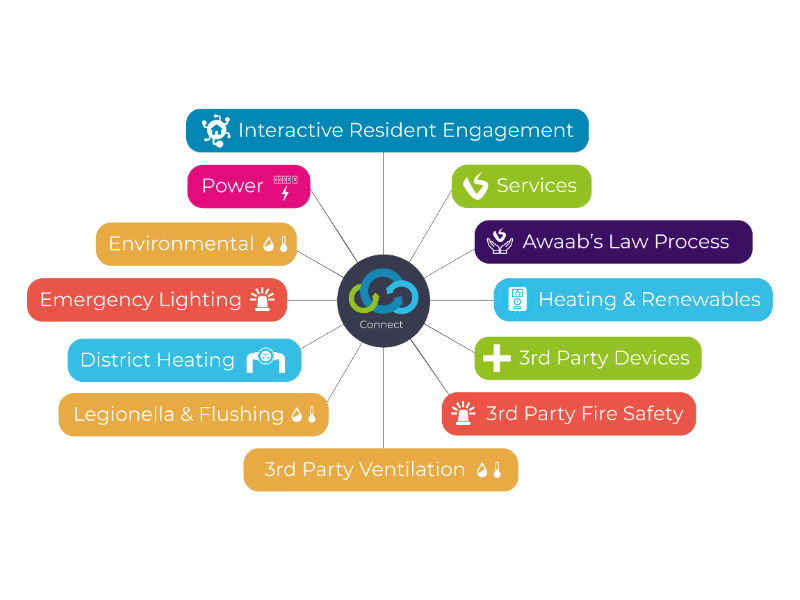

Smoke and CO alarms are no longer enough. As housing regulations evolve—especially with the introduction of Awaab’s Law—landlords need smarter, more proactive tools to protect residents and meet compliance standards. That’s where Vericon Systems comes in.
Our connected ecosystem goes beyond traditional monitoring to offer a comprehensive suite of housing compliance technology—from mould detection and power monitoring to resident engagement and Legionella risk management.
Vericon’s ecosystem is designed to help social housing providers manage multiple risks from a single platform. Each solution works together to deliver real-time insights, automate compliance, and improve resident wellbeing.
Detects early signs of damp and mould—essential for Awaab’s Law compliance.
Monitors temperature, humidity, and dew point to flag environmental risks.
Tracks power usage and identifies faults or outages in real time.
Automates emergency lighting tests and stores results for easy reporting.
Monitors district heating systems for consistent energy delivery.
Manages Legionella risk with automated temperature checks and alerts.
Displays real-time updates to residents via an in-property screen.
Ensures air quality and system performance through our partnership with EnviroVent.
Tracks performance and pressure to prevent breakdowns and improve efficiency.
Traditional alarms are reactive—they alert you after something goes wrong. Vericon’s ecosystem is proactive. It helps housing providers:
With automated reporting, photographic evidence, and date/time-stamped audit logs, Vericon makes compliance simple. Whether it’s emergency lighting, mould risk, or Legionella management, our tools give you the data you need—when you need it.
📘 Download our free guide: BREATHE EASY: A Landlord’s Guide to Awaab’s Law
If you’re still relying solely on smoke and CO alarms, it’s time to rethink your strategy. Vericon’s ecosystem offers a smarter, safer, and more connected way to manage housing risks.
👉 Explore the full ecosystem and see how Vericon can help you go beyond smoke and CO.

Awaab’s Law is moving from headline news to operational reality, with the government releasing updated draft guidance and the 2025 regulations that finally clarify what’s expected of social landlords. If you’re responsible for damp, mould, or hazard management in social housing, these changes are more than just administrative—they represent a fundamental shift in what “best practice” looks like.
Visit our Awaab’s Law Page here.
At Vericon, we know compliance isn’t just about ticking boxes. It’s about protecting residents, reputations, and budgets. Here’s how the latest updates affect you—and how we can help.
Real-Time Damp & Mould Detection:
Our analytics do more than simply flag a problem: they quantify risk and identify causality, ensuring you meet statutory requirements and put an end to recurring cases.
Automated Tracking Deadlines:
From day one, when the clock starts ticking, we create a full date- and time-stamped audit log, along with any photographic evidence captured during surveys. This validates compliance and can be included in your resident correspondence to demonstrate you are actively managing their issues.
Clear Resident Communication:
Simplify and validate your resident communication by including a date- and time-stamped audit log and any photographs captured during the process. Where HomeHub is fitted, this communication and future updates can be accessed via the in-property 7-inch screen.
Guidance and Best Practice:
Our Awaab’s Law landing page and BREATHE EASY guide break down the rules and provide practical, actionable steps for your team.
The Rule:
Inspect any reported or detected hazard within 10 working days.
The Risk:
Tighter timescales increase the risk of missed or late inspections and regulatory breaches.
How Vericon Helps:
Let us take control from day one. Our real-time damp and mould risk management uses causality analytics and photographic evidence to pinpoint the cause of risk—often before a resident needs to complain. Automated workflows schedule and track inspections the moment an alert is raised, ensuring you never miss a regulatory deadline. After your investigation, you’ll have the data and evidence to provide a clear summary of findings to the resident.
**By October 2025, you’ll need systems that can triage risk, schedule and track every inspection, and securely store evidence and notes from every visit.**
The Rule:
Repairs must start within 5 working days of confirming a health-related hazard.
The Risk:
Shorter timescales make contractor coordination and documentation business-critical.
How Vericon Helps:
Our platform logs all confirmed hazards and instantly notifies your maintenance teams. Progress—including photo evidence and install updates—is tracked on a central dashboard, providing real-time validation of work completed. No more “slipped through the cracks”—your teams have instant access to the data they need to keep repairs on track.
**By October 2025, you’ll need systems that track repairs, store photographic evidence, and maintain a full repair history—ready for audit at any time.**
The Rule:
After any inspection, you must provide a written summary to the resident within 3 working days.
The Risk:
Communication failures are now compliance failures.
How Vericon Helps:
Vericon captures and organises all inspection findings, next steps, and timescales in clear, exportable formats—so you can create your written summary with ease. All inspection content and findings are shared with the housing provider via a Vericon report and available on your online dashboard. This information can be shared with residents, ensuring they’re kept updated and know how to stay safe.
**By October 2025, you’ll need to generate plain-language resident reports within 48 hours and log all resident communications.**
The Rule:
Emergencies require attendance and action within 24 hours.
The Risk:
There is no margin for error—delays create immediate risk for residents and your organisation.
How Vericon Helps:
Our 24/7 monitoring flags emergencies in real time. Escalation protocols alert your response teams instantly, with incident logs, quantified risk ratings, and timestamps ready for audit or legal defence. Crucially, our causality analytics identify the root cause—helping you prevent repeat issues.
The Rule:
Where works can’t begin within 5 days due to structural complexity or access, they must commence within 12 weeks.
The Risk:
Ambiguity around “complex works” puts the onus on robust documentation and transparent processes.
How Vericon Helps:
From the moment complex work is identified, real-time monitoring provides pre- and post-works data—validating progress and completion. Every case is fully logged, with all communications, actions, and scheduled works stored securely in one place. This information can be shared with residents, ensuring they’re kept updated and know how to stay safe.
**By October 2025, you’ll need to store full case records—including evidence, communications, and follow-up—securely for at least six years.**
Recent analysis from Clyde & Co highlights the impact: for the first time, the law sets enforceable timeframes for resolving hazards in social housing, with penalties for non-compliance. Residents can now bring claims for breach of these legal duties, and landlords will need to prove not only that hazards were addressed, but that every step—from investigation to communication—was done on time and by the book.
Our technology is built for the future—giving you the tools, data, and evidence to not only comply, but to lead on safety and resident engagement.
Explore our Awaab’s Law landing page and download the BREATHE EASY guide to get ahead of the changes.
Ready to talk about a compliance solution tailored to your portfolio? Contact Vericon today.


The countdown to Awaab’s Law implementation in October 2025 has begun, and recent findings from the Housing Ombudsman have revealed critical failings in social housing inspections. These findings come at a crucial time, as Awaab’s Law will soon require social landlords to investigate and fix damp and mould issues within strict timeframes.
The legislation, named after two-year-old Awaab Ishak who tragically died from exposure to mould in 2020, represents a watershed moment for social housing safety standards. However, the Ombudsman’s latest report highlights systemic inspection failures that must be addressed before Awaab’s Law takes effect.
The report reveals distressing cases where inspection failures have directly impacted residents’ health. In one instance, a baby required an inhaler due to exposure to damp and mould after a landlord failed to conduct proper inspections. Another case saw children sleeping on the floor for two years because their bedroom had become uninhabitable.
Incomplete or Missing Inspections
The Ombudsman identified that many properties either weren’t inspected at all or received inadequate assessments. Our HomeHub system addresses this fundamental requirement of Awaab’s Law by conducting environmental assessments every five minutes. This continuous monitoring ensures housing providers maintain constant oversight, identifying potential issues before they become hazardous.
Conflicting Inspection Results
With Awaab’s Law implementation approaching, conflicting inspection results present a significant compliance risk. Our Surveyor Cube eliminates this issue by providing consistent, accurate data that can’t be misinterpreted. This standardised approach ensures all stakeholders work from the same reliable dataset, crucial for Awaab’s Law compliance.
Disconnect Between Recommendations and Actions
Under Awaab’s Law, housing providers must act promptly on identified issues. Our integrated platform ensures recommendations are properly logged, tracked, and acted upon within the timeframes that Awaab’s Law will mandate. The system maintains a clear audit trail of all identified issues, recommended actions, and completed works.
Poor Communication with Residents
Awaab’s Law emphasises the importance of resident communication. Our HomeHub interface revolutionises this aspect by providing transparent, real-time data access. This aligns perfectly with Awaab’s Law requirements for clear, timely communication with residents about property conditions and remedial actions.
As the October 2025 deadline for Awaab’s Law approaches, the social housing sector must embrace solutions that address these systemic failures. The tragic case of Awaab Ishak demonstrates why traditional inspection methods are no longer sufficient to ensure resident safety and wellbeing.
Housing Ombudsman Richard Blakeway emphasises that under Awaab’s Law, “communication with residents must be open, specific and accurate.” Our solutions are specifically designed to meet these Awaab’s Law requirements, facilitating unprecedented transparency and accountability.
The seven-month countdown to Awaab’s Law implementation means housing providers must act now. By implementing comprehensive monitoring solutions, they can ensure compliance with Awaab’s Law while protecting residents’ health and wellbeing.
The implementation of Awaab’s Law represents more than just new legislation—it’s an opportunity to transform how we approach social housing safety. Our technology provides the tools needed to not only comply with Awaab’s Law but to exceed its requirements, creating safer homes for everyone.
Don’t wait for Awaab’s Law to highlight the importance of proper property monitoring and maintenance. The solutions for comprehensive Awaab’s Law compliance are available today—let’s use them to prevent future tragedies and create better living conditions for all residents.
To learn more about Awaab’s Law or discuss how our secure IoT solutions can benefit your organisation, contact our team today on 01242 582 555 or email [email protected]

In a landmark announcement yesterday, Deputy Prime Minister and Secretary of State for Housing, Communities and Local Government, Angela Rayner, outlined the government’s detailed implementation plan, marking a transformative moment for social housing safety standards in England.
The announcement comes at a critical time, with recent English Housing Survey data revealing that 7% of social rented homes suffered from damp problems and 4% contained the most dangerous ‘category 1’ hazards in 2023. These statistics underscore the urgent need for systematic change in housing safety management.
The government has outlined a clear, three-stage implementation timeline for Awaab’s Law:
Under Awaab’s Law, social landlords will be required to address damp and mould hazards presenting significant health risks within fixed timescales. Importantly, emergency repairs – whether related to damp and mould or other hazards – must be addressed within 24 hours.
The scope will expand to encompass additional critical hazards, including:
Full implementation of Awaab’s Law covering all remaining hazards as defined by the Housing Health and Safety Rating System (HHSRS).
For housing providers and property management organisations, this phased approach offers a crucial window to adapt and enhance their systems and processes. At Vericon Systems, we understand that technology will play a pivotal role in helping social landlords meet these new requirements efficiently and effectively.

The legislation mandates not just repairs within set timeframes but also emphasises the need for proper investigation, documentation, and communication with tenants. Our property management solutions are designed to support housing providers in:
Richard Blakeway, Housing Ombudsman, said: “We welcome these new measures to provide further protections for renters living in hazardous conditions and its extension to private landlords.
“It is a basic human right to live in a safe and decent home. This law is an important step towards helping the millions of people who do not – including 1 million children”
The Deputy Prime Minister’s statement also outlined additional forthcoming reforms, including:
Whilst October 2025 may seem distant, the complexity of these requirements means housing providers should begin preparing now. The government’s emphasis on existing duties remains clear – social landlords must continue meeting their current obligations regarding property safety and habitability.
For organisations managing social housing portfolios, now is the time to evaluate current systems and processes. The right technology infrastructure will be crucial in meeting these new regulatory requirements whilst maintaining efficient operations.
At Vericon Systems, we’re committed to supporting social housing providers through this transition. Our solutions are being enhanced to align with the specific requirements of Awaab’s Law, ensuring our clients are well-positioned to meet their new obligations effectively.
The implementation of this new regulation represents more than just regulatory compliance – it’s about ensuring safe, healthy homes for millions of residents. As we move towards these significant changes, we stand ready to partner with social housing providers in creating better, safer homes for all.
For more information about how Vericon Systems can help your organisation prepare for Awaab’s Law implementation, contact our team today on 01242 582 555 or email [email protected]
Together, we can make a significant impact in combating fuel poverty and ensuring a better future for social housing.